Healthy Eyes Start Outdoors
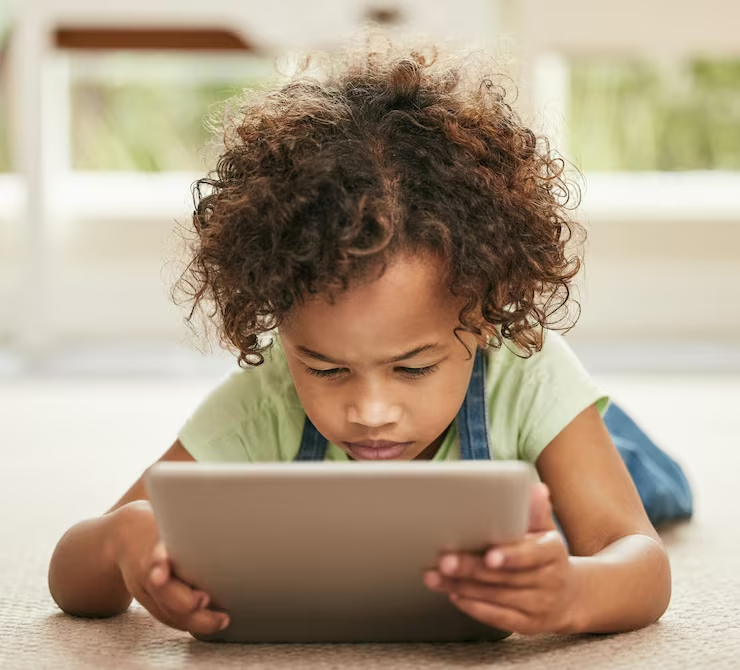
When children spend a lot of time looking at screens, their eyeballs elongate. Yep, you read that right. To keep that close-up screen in focus day after day, the eye adapts by becoming longer, like a balloon being slowly stretched. And once an eyeball "stretches," it cannot revert to its former shape.
Eye doctors worldwide are already sounding the alarm about a "Global Myopia Epidemic." This epidemic isn’t just about needing glasses. It’s about a permanent change to the structure of the eye.
This permanent change is called axial elongation, or myopia, and it occurs when children spend too much time staring at screens less than 8 inches away from their eyes. This change in structural development is most significant between the ages of 5 and 17, but children are at risk of developing this condition even earlier—between the ages of 2 and 5.
As the eye elongates, it also becomes more susceptible to serious eye conditions that can develop later in life, such as glaucoma, retinal detachment, and early blindness.
The World Health Organization (WHO) and the American Academy of Pediatrics are very clear about the limits that parents must enforce to protect a child's vision. If a child consistently exceeds the screen time limits outlined below, the risk of permanent eye damage increases by nearly 80 percent.
- Children aged 2 and younger: Pediatric and global health experts recommend limiting or avoiding screen time altogether until approximately 18 to 24 months of age, except for video chats with family.
- Children ages 2 to 5: Screen time should be limited to about an hour per day of high-quality content and, when possible, shared with an adult.
- Children ages 5 to 17: Experts recommend limiting leisure screen time to no more than two hours per day.
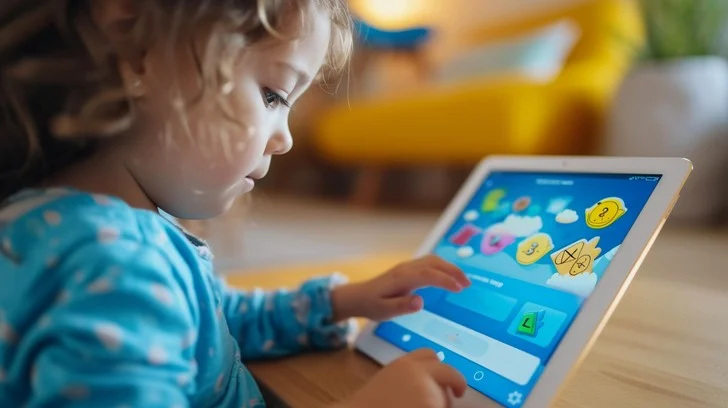
Think of the eye like a tiny muscle. When a child looks at a screen, that muscle is tight and working hard to focus on something just inches away. When a child looks at a tree or a bird across the street, that muscle finally relaxes.
If a child spends hours every day looking at a screen, that “near” muscle is constantly under tension. Over time, the eye continually adapts to this close-up focus, making it harder and harder to see the whiteboard at school or a ball flying through the air.
So what's a parent to do? Here's the good news: You don't have to ban screens entirely. But you do need to balance your child's screen time with other activities—and establish a few simple habits to train your child's eyes so they don't get stuck in "near-focus mode."
These recommendations from eye doctors work best when they’re treated as gentle reminders, rather than strict rules:
- The 20-20-20 Rule: Every 20 minutes, encourage your child to take a 20-second break to look at something at least 20 feet away.
- The Elbow Rule: When your child is using a tablet, the screen should be about an elbow-to-hand distance from your child's face. If the screen is any closer, your child's eyes will have to work much harder to focus.
- The Remember-to-Blink Rule: When children focus on screens, they blink far less than usual, which can leave their eyes feeling dry and tired. Encourage your child to take quick “blink breaks” to help alleviate eye fatigue and dryness.

Eye care specialists also emphasize the importance of combining screen time limits with daytime outdoor play, because sunlight supports healthy eye development.
Natural daylight is many times brighter than indoor lighting—even on a cloudy day. Daylight signals the eye to release a natural chemical that helps prevent the eye from "stretching."
- One to two hours of daytime outdoor play each day can help reduce the risk of axial elongation.
- Cloudy days still count: Outdoor light on an overcast day is still far brighter than typical indoor lighting.
- Shade counts: Sitting under a tree or on a porch still supports healthy eye development.
- Even calm activities help: Walking, reading, or doing homework outside support eye health by providing natural light and giving the eyes a chance to focus on distant objects.
Screens are an incredible tool for learning and connection, but they were never meant to be the only view that our children have of the world. By reducing screen time and using small habits such as the Elbow Rule and the 20-20-20 Rule, we are preventing eyestrain today and protecting the physical health of our children's eyes for decades to come.
The goal isn’t to live without technology, but to ensure that screens don't distort our children's anatomy. Whether it’s advocating for more outdoor recess at school or simply choosing to do homework on the porch instead of the couch, every bit of natural light and “distance vision” counts!